BISE Lahore Practical Exam Matric & Intermediate Guidelines 2026: New Rules for Matric & Inter
BISE Lahore Practical Exam Matric & Intermediate Guidelines 2026 are recently published by official boards. Are you preparing for your Matric or Inter practical exams in 2026? The Board of Intermediate and Secondary Education (BISE) Lahore has just released Practical Exam Matric & Intermediate Guidelines 2026, a strict new set of instructions that every student and examiner must follow. These aren’t just suggestions—failure to follow these rules could lead to your practical being cancelled or even a permanent ban. In this guide, we break down the official notification into simple steps so you can protect your marks and stay out of trouble.
Tips for Students & Teachers
For Students: Do NOT buy “ready-made” notebooks from the Urdu Bazar or local shops. The examiners are specifically trained to spot market-printed handwriting. If caught, you won’t just lose marks; a UMC (Unfair Means Case) will be registered against you.
For Teachers: Ensure you sign the title page of every student’s notebook. An unsigned notebook is now a red flag for the Resident Inspectors.
On Exam Day: Leave your mobile phone at home or with your parents. Even if it’s switched off in your pocket, you can be disqualified if it’s found inside the lab.
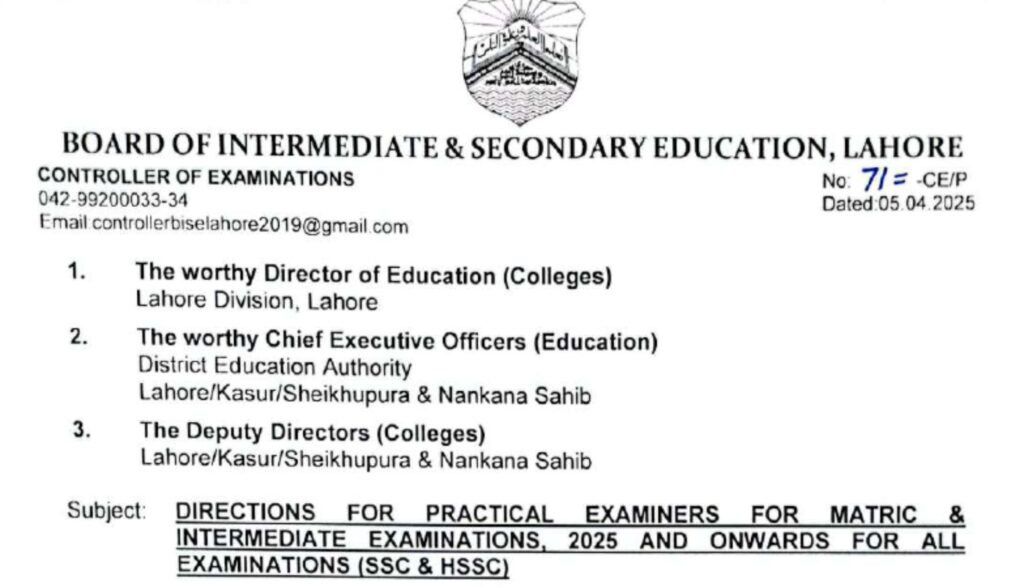
The Board of Intermediate and Secondary Education (BISE), Lahore, has issued comprehensive directions for Practical Examiners and Resident Inspectors (RIs) for all Matric (SSC) and Intermediate (HSSC) examinations from 2026 onwards. These guidelines are designed to maintain academic integrity, fairness, and transparency during practical examinations. Adherence to these rules is mandatory, and any breach may lead to disciplinary action, suspension, or permanent disqualification from BISE duties.
This article explains these directions in detail, including rules for examiners, lab staff, students, and institutions.
1. Adherence to Practical Notebook Regulations
- All practical note books must comply with the official punching and binding rules as issued by BISE (vide No.09004/COE/PRACTICALS, dated 09-04-2024).
- Only handwritten, self-prepared notebooks are valid for awarding marks.
- Market-prepared or pre-written notebooks are strictly prohibited. Students found with such notebooks will face a Unfair Means Case (UMC) under Section 3(a)(viii) of the Punjab University and BISE Malpractice Act, 1950 (amended 1999).
- Science teachers must certify the authenticity of notebooks on the title page before submission.
2. Rules for Mobile Phone Usage
- Practical Examiners, RIs, and visiting officers are strictly prohibited from carrying mobile phones inside laboratories.
- Phones must be handed over to Resident Inspectors or stored in vehicles during examinations.
- Examiners may record results on notebooks but must enter data into phones only after leaving the lab.
- Violation of this rule may lead to cancellation of duty and permanent ban from BISE practical duties.
3. Role and Responsibilities of Resident Inspectors (RIs)
- RIs must ensure no unauthorized persons enter laboratories. Only appointed staff may assist practical examiners.
- They are responsible for appointing officials of integrity and honesty to support practical examinations (vide BISE No.1405-A/Grade-I Directions, dated 14-05-2024).
- Any misconduct, including assisting students, allowing cheating, or unauthorized supervision, can result in removal from duty and blacklisting of the institution for future examinations.
- RIs must strictly supervise practical examiners and lab attendants to prevent any malpractice.
4. Conduct During Practical Exams
- Candidates must perform practicals independently without any assistance.
- Practical exams are a mandatory part of the examination and must be conducted with proper monitoring.
- No teacher, helper, or unauthorized personnel is allowed in the laboratory during the exam.
- All required equipment should be arranged properly and ready for candidates.
- Practical notebooks should be prepared in students’ own handwriting and verified by science teachers.
5. Unfair Means and Misconduct
- UMC cases will be registered against candidates found using unfair means, including cheating from practical notebooks or other sources.
- Any lab examiner, lab attendant, or unauthorized person attempting to collect or sell practical notebooks will face FIR under anti-corruption laws.
- If any examiner, RI, or helper is found assisting students or managing practicals unfairly, strict action including suspension, removal, or institutional blacklisting will be enforced.
6. Legal and Regulatory Framework
The guidelines are in accordance with:
- PEEDA Act, 2006 (for ethical conduct and disciplinary measures)
- Punjab University and BISE Malpractice Act, 1950 (amended 1999)
- BISE-specific directions for practical note books and laboratory conduct
This ensures full compliance with educational regulations while safeguarding the integrity of Matric and Intermediate examinations.
7. Key Points for Institutions
- Institutions must guide students well in advance regarding practical preparations.
- Practical exams are strictly monitored, and all rules for equipment, notebooks, and examiners’ conduct must be followed.
- Students should prepare and submit authentic, handwritten practical notebooks.
- Only authorized staff may assist in the laboratory; no outsider or unauthorized helper is allowed.
8. Summary of Responsibilities
| Stakeholder | Responsibility |
| Practical Examiners | Conduct exams fairly, no phone use, no assisting students, follow notebook rules |
| Resident Inspectors (RIs) | Supervise labs, appoint honest staff, prevent unauthorized access, enforce rules |
| Students | Prepare own notebooks, perform practicals independently, follow exam instructions |
| Institutions | Provide required equipment, guide students, ensure exam integrity, comply with BISE rules |
9. Conclusion
The BISE Practical Examination Guidelines 2026 and onwards aim to ensure transparency, fairness, and quality in science education. Strict enforcement of these rules will prevent cheating, malpractice, and corruption, safeguarding both students’ interests and institutional credibility.
Students, teachers, and examiners are strongly advised to adhere to all instructions meticulously, as non-compliance may result in severe penalties, including suspension, blacklisting, and legal action.